
Stop Researching and Start Shipping: The Stack That Works
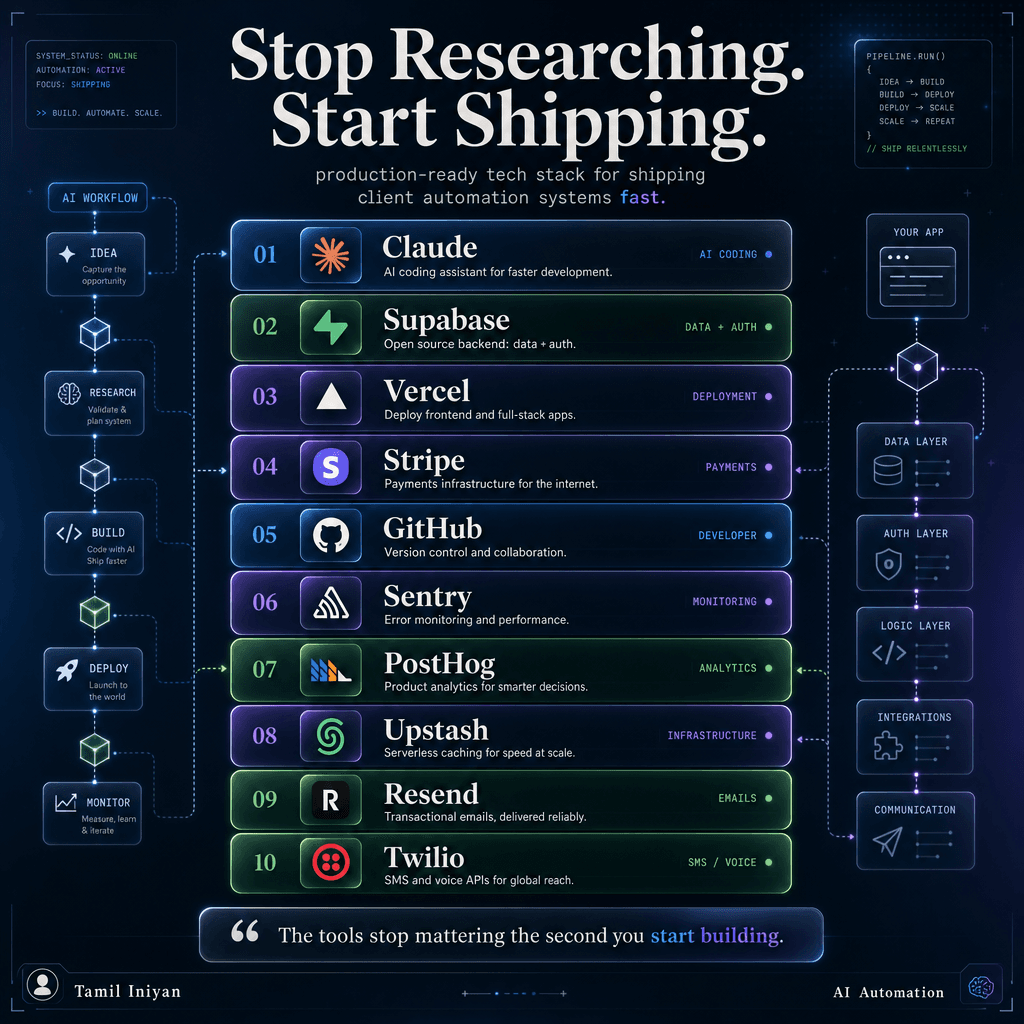
TL;DR: Tool paralysis is killing your velocity. After building 40+ systems for agencies, I use one stack for everything: Claude, Supabase, Vercel, Stripe, GitHub, Sentry, PostHog, Upstash, Resend, and Twilio. Your client does not care which database you picked. They care if leads land in their inbox every morning.
Most agency founders are not shipping because they are researching.
They spend 3 weeks comparing databases. Another 2 weeks reading deployment guides. Then they find a new tool and start over.
This is not building. This is procrastination with a technical costume.
I have seen this pattern 40 times. A founder reaches out about building a lead system. We scope the project. Then they disappear for a month. When they come back, they ask if we can use Firebase instead of Supabase because they read a blog post. Or they want to switch from Vercel to Railway because someone on Twitter said it was faster.
The research never ends. The system never ships.
Here is what changed for me: I stopped optimizing the stack and started optimizing for speed.
The Stack I Use for Every Client Build
After building 40+ lead generation and nurturing systems for marketing agencies, I use the same stack every time:
Claude handles the logic and code. I am not a developer. Claude writes the workflows, API calls, and error handling. I review it, test it, and ship it.
Supabase stores user data and handles auth. Postgres database, built-in authentication, real-time subscriptions, and vector storage if the system needs AI memory. One service instead of duct-taping three together.
Vercel puts the system live in 60 seconds. Git push and it is deployed. No server configuration. No Docker files. No DevOps theatrics.
Stripe handles payments. If the client needs to charge for the lead system or offer a paid tier, Stripe is already wired in.
GitHub manages version control and triggers the deployment pipeline. Every commit runs through CI/CD without me thinking about it.
Sentry catches bugs before clients see them. Real-time error tracking with stack traces. If something breaks, I know about it before the client does.
PostHog records session replays and tracks user behavior. When a client says "the form is not working," I watch the exact session and see what happened.
Upstash handles caching and rate limits. Redis without the server management overhead. Keeps API costs low and response times fast.
Resend sends transactional emails. Lead notifications, password resets, weekly reports. Built for developers, not marketers pretending to be developers.
Twilio powers SMS and voice when the workflow needs it. Some clients want text alerts when a high-value lead comes in. Twilio handles it without me building a phone system.
This is not the only stack that works. It is just the one that works without me thinking about it anymore.
Why This Stack Wins
The AI market grew 40% year over year from $279 billion in 2024 to $390 billion in 2025. That growth is not coming from people researching better tools. It is coming from people who picked a stack and started shipping.
Launch Fast hit $20,000 in monthly recurring revenue 90 days after a 48-hour build using an AI-augmented stack. Virtual Staging AI scaled from $20,000 to $200,000 MRR as an indie project. These are not venture-backed teams with 10 engineers. These are builders who stopped choosing and started shipping.
Devolver Digital shipped game websites 73% faster with Vercel. Morning Brew saw a 2.5x revenue increase after adopting Vercel for their frontend. Decathlon automated 2,000+ customer conversations per week with a chatbot built on a similar stack, generating over €10,000 in revenue at a 96% resolution rate.
The pattern is clear: velocity matters more than perfection.
After building 40+ systems for agencies, here is what I learned:
The tools stop mattering the second you are actually building.
Your client does not care if you used Supabase or Firebase. They care if leads are landing in their inbox every morning. They care if the follow-up sequence runs without them touching it. They care if the reporting dashboard loads in under 2 seconds.
Nobody has ever asked me which database I used after I delivered a system that pulled 500 enriched leads from Apollo, validated them, and pushed them into a WhatsApp nurture sequence with zero manual steps.
The 3 Mistakes That Keep Agencies Stuck
Mistake 1: Tool paralysis
Agency founders waste weeks comparing Firebase versus Supabase. They read 12 blog posts about Next.js versus Remix. They ask ChatGPT which hosting provider is faster.
None of this matters if you are not shipping.
Pick one stack. Ship with it. Move on.
Mistake 2: Over-engineering the backend
I have seen agencies spend 2 months building a custom authentication system from scratch when Supabase gives you auth, database, and real-time subscriptions out of the box.
You are not building Google. You are building a lead system for a 5-person agency. Use the tools that handle the boring infrastructure so you can focus on the part that actually generates revenue for the client.
Mistake 3: Ignoring CI/CD
Manual deploys kill velocity. Every time you SSH into a server to upload files, you are slowing yourself down.
GitHub and Vercel give you automatic deployments. You push to main, and the system is live 60 seconds later. If something breaks, you roll back with one click.
87% of teams using incremental adoption of Next.js and Vercel reported massive decreases in build times. The faster you deploy, the faster you iterate. The faster you iterate, the faster you ship.
How to Stop Researching and Start Shipping
Here is the workflow:
Step 1: Pick the stack above and commit to it for 90 days. Do not switch tools in the middle. Do not second-guess the decision. Just build.
Step 2: Start with the smallest possible system. If you are building a lead generation workflow, start with Apollo pulling 50 leads per day, n8n enriching them, and pushing them into a Google Sheet. Ship that first. Then add the WhatsApp sequence. Then add the email follow-up. Then add the dashboard.
Step 3: Ship daily. Even if the system is not perfect. Even if there are edge cases you have not handled yet. Git push every day. The faster you ship, the faster you learn what actually matters.
Step 4: Use AI for the code. Claude writes 80% of the logic. You review it, test it, and fix the edge cases. After 40 builds, I can ship a production-ready lead system in under a week because Claude handles the repetitive code and I handle the strategy.
Step 5: Document as you build. Every workflow gets a Loom walkthrough. Every API integration gets a one-page doc. When the client asks how something works 3 months later, you send them the video instead of rebuilding your memory.
70% of AI teams use vector databases like Supabase because infrastructure is maturing. The tools are good enough now. The bottleneck is not the stack. The bottleneck is the builder who keeps researching instead of shipping.
The Real Problem Is Not the Tools
The agencies winning right now are not the ones with the best tools. They are the ones who stopped choosing and started shipping.
I am not saying this stack is perfect. I am saying it works. It works for lead generation systems. It works for client dashboards. It works for automated reporting. It works for WhatsApp nurture sequences.
After you ship 10 systems with this stack, you will know where it breaks. Then you can swap out one piece at a time. But if you are still comparing databases after 3 weeks, you are not building. You are researching.
Stop researching the perfect combo. Pick one stack. Ship with it. Move on.
The tools stop mattering the second you are actually building.
How Flownix Labs Can Help
At Flownix Labs, we build done-for-you lead generation, enrichment, and nurturing systems for small marketing agencies. We use the exact stack outlined in this article. Every system is production-ready in under a week. No tool paralysis. No endless research. Just builds that run without anyone touching them.
If your agency is still dependent on referrals and manual follow-up, we can build the pipeline that fixes that. Apollo pulls the leads. n8n enriches and sequences them. WhatsApp, email, or LinkedIn delivers the outreach. You get discovery calls booked every week without doing manual prospecting.
Visit flownixlabs.com to see how we work.
Share this article
Spread the knowledge with your network.
ENTERPRISE SOLUTIONS