
Which Claude Model to Use: Opus, Sonnet or Haiku
Most agencies use the wrong Claude model for the job. They run Opus for everything and burn $300 a month. Or they use Haiku for research and wonder why the output is basic.
The fix is simple. Three models. Three jobs. One decision tree.
TL;DR
Sonnet 4.6 handles daily automations and customer support. Haiku 4.5 processes bulk operations at the lowest cost. Opus 4.7 tackles deep reasoning and multi-step planning. Choose wrong and you either blow your budget or get mediocre outputs. Choose right and you save 50% costs while shipping 2x faster.
The Real Cost of Using the Wrong Model
Here is what actually happens when agencies pick the wrong Claude model.
A 5-person marketing agency runs Opus 4.7 for everything. Email drafts. Slack summaries. Customer support replies. Their API bill hits $450 in one month because Opus costs around $15 per million input tokens. They could have used Sonnet 4.6 for those tasks and paid $120 instead.
Another agency uses Haiku 4.5 to analyze 50-page research reports. The output is surface-level because Haiku has a 200K token context window and no deep reasoning capability. They waste 6 hours rewriting what Opus 4.7 would have nailed in one pass.
Anthropic released data in August 2025 showing that Claude 4 models cut API costs by 40% for enterprise users compared to the 3.x series. But only if you use the right model for the task. When 85% of users upgraded from Claude 2 and 3 to 4.x in July 2025, the ones who mapped models to workflows saw immediate cost drops. The ones who defaulted to Opus for everything saw bills spike.
The pattern is clear. Agencies waste 30% of their AI spend because they do not know which model fits which task.
Sonnet 4.6: Speed and Reliability
Sonnet 4.6 is your workhorse. Released in August 2025, it handles 1 million token context windows and outputs up to 64K tokens. The knowledge cutoff is August 2025.
Use Sonnet when the task repeats daily and needs speed.
Customer support agents that respond in under 3 seconds. Drafting 200 emails in one batch. Running automations with Slack or Google Drive that fire every hour. Sonnet executes these at moderate cost with consistent output quality.
A financial platform case study from Anthropic in April 2026 showed that teams using Sonnet 4.6 for everyday tool integrations maintained 2x faster dev velocity compared to older models. The Model Context Protocol standardizes how Sonnet connects to tools like Slack and Drive. You set up the connector once and batch tasks into single prompts.
The workflow is simple. Connect Sonnet to your tools via Connectors. Write one prompt that handles 50 inputs instead of 50 separate API calls. Sonnet processes the batch in under 10 seconds.
Do not use Sonnet for deep reasoning tasks. It will give you a correct answer but miss the nuance. Save Sonnet for high-frequency execution where speed and reliability matter more than depth.
Haiku 4.5: Volume and Efficiency
Haiku 4.5 is the lowest-cost model in the Claude 4 family. Released in February 2025, it processes 200K token context windows and outputs up to 64K tokens. Knowledge cutoff is February 2025.
Use Haiku when you are processing thousands of inputs and cost matters.
Summarizing 5,000 customer messages daily. Classifying or tagging data in bulk. Building chat agents where token cost compounds fast because users send 100 messages per session. Haiku handles high throughput at the lowest cost.
FlowHunt published a case study in their Agent SDK showing that Sonnet 4.5 processed over 10,000 tasks per day at 70% lower cost compared to Opus. They used Haiku for bulk classification and Sonnet for tool integrations. The cost difference was $50 per month versus $180 per month for the same volume.
The best practice with Haiku is to edit your message instead of sending follow-ups. Each new message costs tokens. If you send 3 follow-up corrections, you just tripled your cost. Start a new chat for every new topic because Haiku does not handle long conversation threads as well as Sonnet or Opus.
Do not use Haiku for complex reasoning. It will give you a lightweight answer that misses depth. Save Haiku for high-volume operations where the task is simple and cost is the priority.
Opus 4.7: Depth and Reasoning
Opus 4.7 is the heavy hitter. Released on April 16, 2026, it handles 1 million token context windows and outputs up to 128K tokens. Knowledge cutoff is January 2026.
Use Opus when the task requires deep reasoning or multi-step thinking.
Analyzing 80-page legal contracts. Synthesizing 20 research papers into one strategic brief. Autonomous coding agents that write and debug production-ready workflows. Long-horizon planning where the AI needs to reason through 10 interdependent steps before acting.
Anthropic published a case study in April 2026 showing that a financial platform used Opus 4.7 for unsupervised complex coding. The platform accelerated dev velocity by 2 to 3x for millions of users because Opus handled edge cases and dependencies that Sonnet would have missed.
The best practice with Opus is to use high effort mode for coding and agentic tasks. Thinking is adaptive in Opus 4.7, meaning you do not need to set a manual token budget. Opus decides how much reasoning time it needs. Be explicit in your instructions. Opus 4.7 follows instructions literally. If you say "write a function that handles edge cases," Opus will write that function. If you say "write a function," Opus will write a basic version.
Do not use Opus for everyday tasks. You will burn budget 3x to 5x faster than necessary. Save Opus for tasks where depth is your differentiator.
Comparison Table
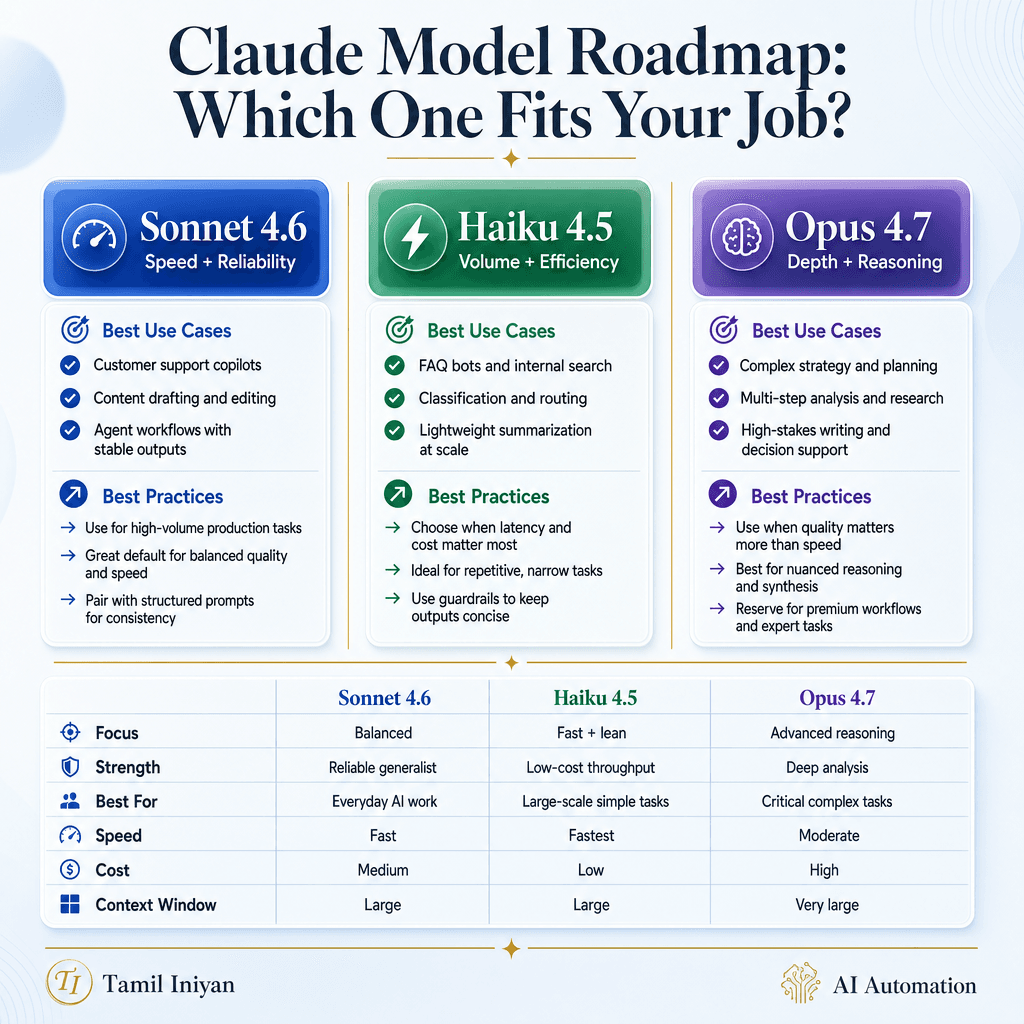
| Model | Focus | Strength | Best For | Speed | Cost | Context | |-------|-------|----------|----------|-------|------|---------| | Sonnet 4.6 | Speed + Reliability | Everyday tasks, tool use, consistent output | Support agents, docs, daily automations | Fast | Moderate | 1M tokens | | Haiku 4.5 | Volume + Efficiency | High throughput, low cost, bulk processing | Bulk ops, classification, summaries | Fastest | Lowest | 200K tokens | | Opus 4.7 | Depth + Reasoning | Complex reasoning, long horizon planning | Research, analysis, planning | Slower | Highest | 1M tokens |
The cost difference is real. Opus costs around $15 per million input tokens. Sonnet costs moderate. Haiku costs the lowest. If you process 10 million tokens per month, choosing Haiku over Opus saves you $120 to $140 per month.
Common Mistakes Agencies Make
Overusing Opus for bulk tasks like email drafting inflates budgets by 3 to 5x. A 10-person agency drafting 500 emails per week does not need Opus. Sonnet handles that in one batch at 70% lower cost.
Ignoring model deprecations. Claude 2 and 3 were retired on July 21, 2025. Agencies that did not pin model IDs saw 15% API failures after the retirement. Pin your model IDs in production. Use claude-opus-4-7, claude-sonnet-4-6, or claude-haiku-4-5.
Using Haiku for reasoning tasks. Haiku gives you a lightweight answer that misses nuance. If the task requires depth, use Opus. If the task is simple and high-volume, use Haiku.
Not batching prompts with Sonnet. Sending 50 separate API calls costs 10x more than one batch prompt. Batch your tasks into single prompts when using Sonnet.
The Decision Rule
If the task repeats daily and needs speed, use Sonnet 4.6.
If you are processing thousands of inputs and cost matters, use Haiku 4.5.
If the task requires deep reasoning or multi-step thinking, use Opus 4.7.
That is the entire decision tree. Map your workflows to these three models and you will save 50% costs while shipping 2x faster.
How Flownix Labs Can Help
We build done-for-you lead generation, enrichment and nurturing systems for marketing agencies. Every system we deliver uses the right Claude model for each task.
Lead scraping and enrichment runs on Haiku because it processes thousands of records daily at the lowest cost. Outreach sequences run on Sonnet because they need speed and reliability. Deep research synthesis runs on Opus because it requires multi-step reasoning.
Your workflows get mapped to the right model. Your API bill stays predictable. Your outputs stay high-quality.
If your agency is spending $300 per month on Claude and you are not sure which model you are using, that is a problem we fix in one week.
Start Using the Right Model Today
Visit flownixlabs.com to see how we map Claude models to your workflows. Stop burning budget on the wrong model. Start shipping faster with the right one.
Share this article
Spread the knowledge with your network.
ENTERPRISE SOLUTIONS